


Should I enroll under group NPI or individual NPI?

Ever thought about if your medical practice uses the right billing codes for easy payment? The world of healthcare administration can be like trying to solve a puzzle without a picture. Many providers get stuck deciding between different ways to register their credentials.
Choosing the right NPI enrollment options is key for any doctor. This choice affects how claims are processed and your office's money flow. Knowing the NPI registration process well can save you from delays and headaches.
This guide helps you understand the differences between these two common identifiers. By learning how to choose NPI type, you can manage your practice better. Let's look at the important details every healthcare worker needs to know to make the right choice.
Key Takeaways
Distinguishing between provider types is essential for accurate billing.
Proper registration prevents common claim denials from insurance payers.
The choice depends on your specific practice structure and tax status.
Correct identification ensures faster reimbursement for medical services.
Consulting official guidelines helps maintain compliance with federal standards.
Understanding the Basics of National Provider Identifiers
National Provider Identifiers (NPIs) are key in healthcare billing and management. They are unique numbers for healthcare providers. The Centers for Medicare and Medicaid Services (CMS) gives these 10-digit numbers to providers.
NPIs make healthcare tasks like billing easier. There are two main types: Individual NPI and Group NPI. Knowing the difference helps providers manage their work better.
What is an Individual NPI?
An Individual NPI is for one healthcare provider, like a doctor or nurse. It tracks their billing and work in different places.
For example, a solo doctor uses their Individual NPI for billing. This number stays with them, even if they move or join a new group.
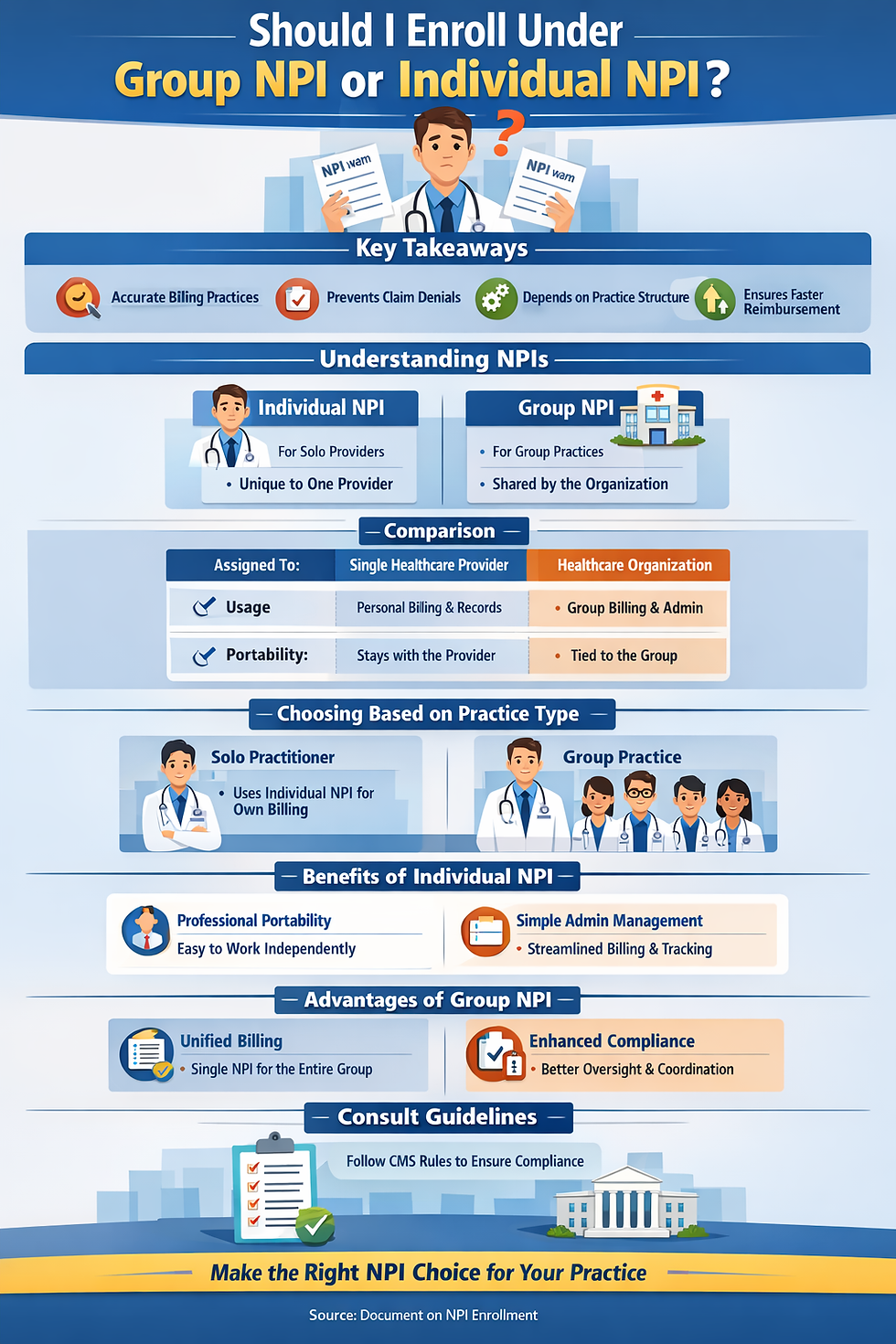
What is a Group NPI?
A Group NPI is for a healthcare group or organization. It's used for billing and tasks for the group as a whole.
Like a multi-specialty group, they have a Group NPI for billing and tasks. This is for the group, not individual providers.

The table below shows the main differences between Individual NPI and Group NPI:
Characteristics | Individual NPI | Group NPI |
Assigned to | Single healthcare provider | Healthcare organization or group practice |
Usage | Medical Billing and administrative tasks for individual providers | Billing and administrative tasks for group practices |
Portability | Remains with the individual provider | Associated with the group practice |
Determining Your Practice Structure and Billing Needs
Healthcare providers must think carefully about their practice structure. It affects their medical billing processes and NPI choice. Choosing to work alone or with others is key. It impacts how well the practice runs and follows health rules.
The type of healthcare practice matters a lot. It shapes how the practice handles patient care, admin tasks, and money. Knowing the differences between solo and group practices is key for picking the right NPI.
Solo Practitioners vs. Group Practice Models
Solo practitioners work alone, handling their own practice. They don't have other providers to help. On the other hand, group practices have many providers working together. They share resources and have a bigger support system.
For billing, solo practitioners face simpler tasks. They just need to bill under their own NPI. But group practices have it tougher. They must coordinate billing for all providers under the right NPI.

Choosing between an individual NPI and a group NPI depends on billing needs. Solo practitioners usually just need their own NPI. But group practices need both individual NPIs for each provider and a group NPI.
Billing rules also affect how easy or hard it is to get an NPI. Group practices must handle both individual and group NPIs. This makes their admin tasks more complex.
Understanding billing needs and practice type is vital for NPI choice. By carefully thinking about these, providers can make a choice that helps their practice run smoothly and follow health rules.
Evaluating the Benefits of Individual NPI Enrollment
Getting an individual NPI brings many benefits to healthcare providers. It makes their work more flexible and easier to manage. This is very helpful for solo practitioners who need to keep their practice running smoothly.
Maintaining Professional Portability
Having an individual NPI lets healthcare providers move easily between different jobs. They can switch from one medical group to another or start their own practice. They don't need a new identifier for this.
Professional portability is key in today's fast-changing healthcare world. Providers might change jobs or settings many times. An individual NPI keeps their professional identity steady and helps avoid billing and patient care issues.
Simplified Administrative Tracking for Solo Providers
Solo providers get a lot from having an individual NPI. It makes simplified administrative tracking easier. They can handle billing, claims, and other tasks without the hassle of shared identifiers.
Administrative Task | With Individual NPI | Without Individual NPI |
Billing and Claims | Streamlined and efficient | Complex and time-consuming |
Simplified tracking and reporting | Difficult to manage and track | |
Easier to maintain and update credentials | More challenging due to shared identifiers |
In summary, getting an individual NPI is a big plus for healthcare providers, and solo practitioners. It boosts their career flexibility and makes admin tasks simpler.
Analyzing the Advantages of Group NPI Enrollment
Group NPI enrollment brings many benefits to multi-provider practices. It makes administrative tasks easier and boosts efficiency. With a Group NPI, healthcare groups can handle billing better and cut down on the hassle of individual NPIs.
Streamlining Claims for Multi-Provider Practices
One big plus of Group NPI enrollment is how it simplifies claims for groups. It lets many providers use one identifier for claims, making billing easier and less work.
Key benefits of streamlined claims processing include:
Less paperwork and work for admins
More accurate claims
Quicker payment times
To show how Group NPI helps with claims, let's compare:
Aspect | Individual NPI | Group NPI |
Claims Submission | Many claims with different NPIs | One claim with a Group NPI |
Administrative Burden | More work with many identifiers | Less work with one billing |
Reimbursement Cycle | Longer times for varied processing | Quicker with streamlined process |
Enhancing Credentialing Efficiency
Group NPI enrollment also makes credentialing easier for groups. Credentialing checks if providers are qualified and real. With a Group NPI, groups can use one identifier for all, making credentialing simpler.
Credentialing gets better in many ways:
Less paperwork and forms
Streamlined checks for all providers
Better meeting of rules and standards
By joining a Group NPI, groups can make their work easier. They can focus more on caring for patients.
Should I enroll under group NPI or individual NPI for my specific situation?
Deciding between a group NPI or individual NPI depends on your job and future goals. It's important to choose wisely to meet your practice's needs.
Assessing Your Current Employment Status
Your job status is key in picking the right NPI. Solo practitioners might prefer an individual NPI. But, if you work in a big healthcare group, a group NPI could be better.
Think about these job-related factors:
Do you work in a hospital or a private clinic?
Are you alone in your practice or part of a team?
Do you want to start your own clinic or join one?
Considering Future Practice Growth and Expansion
Future plans also matter. If you're growing your practice or joining a bigger group, think about your NPI needs.
Important growth factors include:
Will you hire more doctors or staff?
Are you thinking of merging with another clinic or opening new locations?
How might new healthcare rules affect your practice?
Here's a comparison to help you decide:
Factor | Individual NPI | Group NPI |
Employment Status | Good for solo doctors or those who like to move freely. | Best for clinics with many doctors or big organizations. |
Practice Growth | May need more work as your practice grows. | Helps with claims and credentials for big clinics. |
Administrative Burden | Easier to manage for solo doctors. | Can be more complex for big groups. |
By looking at your current job and future plans, you can choose the best NPI for you.
Step-by-Step Guide to Registering for an Individual NPI
Getting an individual NPI is easy if you pay attention and have the right papers. Healthcare providers can easily sign up by following these steps.
Gathering Necessary Documentation
Before you start, make sure you have all the necessary documentation. You'll need:
Personal identification documents (e.g., driver's license or passport)
Professional credentials (e.g., medical license or certification)
Tax-related documents (e.g., Social Security Number or Employer Identification Number)
Having these documents ready will make the application process smoother.
Navigating the NPPES Application Portal
The NPPES application portal is where healthcare providers apply for an individual NPI registration. To use the portal:
Go to the NPPES website and create an account if you don't have one.
Complete the application form with all the needed information, making sure it's correct and complete.
Upload the necessary documents as the application guidelines say.
Check your application and submit it.
After you submit, the application will be reviewed. Once approved, you'll get your individual NPI.
By following these steps and making sure all information is correct, healthcare professionals can get their individual NPI through the NPPES application portal.
Step-by-Step Guide to Registering for a Group NPI
Registering for a Group NPI is key for multi-provider practices. It makes claims and credentialing easier. To register, healthcare groups must define their structure and link providers to the Group NPI.
Defining the Organizational Entity
The first step is to define the organizational entity. You need to know the legal business name and the type of healthcare organization. This could be a group practice, a hospital, or any
other healthcare provider organization.
To define the entity, you'll need:
Legal business name
Business address
Type of healthcare organization
Tax Identification Number (TIN)
Linking Individual Providers to the Group
After defining the entity, link individual providers to the Group NPI. This means associating their individual NPIs with the Group NPI. You'll need to document and update information to meet regulatory needs.
The table below shows the steps and info needed to link providers:
Step | Description | Required Information |
1 | Identify individual providers | Names and NPIs of providers |
2 | Associate providers with Group NPI | Group NPI, TIN, and provider NPIs |
3 | Verify and update information | Accurate and up-to-date provider data |
By following these steps and keeping information accurate, healthcare groups can register for a Group NPI. This streamlines their administrative work.
Comparing Administrative Burdens and Compliance
Choosing between an individual NPI and a group NPI is a big decision. It's important to know about the administrative burdens and compliance needs. Both options have different impacts on healthcare providers, affecting how they report and update their information.
Reporting Requirements for Individual vs. Group
Individual NPIs are for solo practitioners, making reporting easier. Group NPIs, on the other hand, are more complex. They need to combine data from many providers in the group.
Key differences in reporting requirements include:
Individual NPIs have simpler reporting, tied to one provider.
Group NPIs need detailed and coordinated reporting for the group's activities.
Efficient reporting is key for staying compliant and getting paid.
Managing NPI Updates and Changes
Handling updates and changes is vital for NPI management. Solo practitioners have more control over their data. Changes are directly tied to their personal NPI.
For group NPIs, updates need coordination among many stakeholders.
Individual NPI holders can manage changes themselves.
Group NPI updates involve more steps, making it harder.
Knowing these differences helps healthcare providers stay compliant and reduce administrative work.
Common Pitfalls When Choosing Your NPI Designation
Choosing an NPI designation can be tricky. Providers need to watch out for common mistakes to avoid problems later. Making the right choice is key to running your practice smoothly and following the rules.
Healthcare providers often face challenges when getting an NPI. These can affect their billing, credentialing, and how they manage their practice. Two big problems are duplicate registrations and misclassifying NPIs.
Avoiding Duplicate Registrations
Duplicate registrations happen when a provider or group makes multiple NPIs by mistake. This can cause trouble with billing and credentialing. To avoid this, providers should make sure they enter data correctly and consistently when registering.
It's important to check that all your information is right and matches what's already on file. To lower the chance of duplicate registrations, providers can:
Use one person to handle NPI registration to keep things consistent.
Make sure all important numbers, like Tax Identification Numbers (TINs), are correct.
Keep your records up to date to reflect any changes in your practice or job.
Correcting Misclassification Errors
Misclassifying an NPI can cause problems with getting paid and analyzing data. To fix these errors, providers need to know the different types of classifications and make sure they're right.
Providers should know the different types of classifications and check that their NPI fits into the right one. Regular checks of your NPI records can help find and fix any mistakes. This ensures you get paid correctly and stay in line with the rules.
To avoid misclassifying, providers should:
Double-check their NPI classification when they register.
Know the different types of classifications and what they mean.
Update your records often to show any changes in your practice or job.
By knowing about these common problems and taking steps to avoid them, healthcare providers can have a smooth NPI enrollment process. This helps keep their practice running well.
Integrating NPI Choices with Insurance Credentialing
It's important for healthcare providers to know how NPI choices work with insurance credentialing. This ensures that payments go smoothly. The National Provider Identifier (NPI) is key in this process.
Insurance credentialing checks if healthcare providers are qualified. It also makes sure their NPI info is correct. This is important for claims to be processed right.
Payer Perspectives on Group vs. Individual Identifiers
Payers have different views on group versus individual NPIs. Knowing these views helps healthcare providers do well in credentialing.
Payers like group NPIs for practices with many providers. They see individual NPIs as key for solo or group practice providers.
"The use of NPIs has simplified the process of claims submission and has reduced the administrative burden on healthcare providers."
Ensuring Proper Reimbursement Flow
To get payments right, healthcare providers must link their NPI to their insurance info. They need to make sure all billing info is correct and up-to-date.
Keeping data current is key for smooth payments. Providers should update their info with payers quickly.
NPI Type | Payer Preference | Reimbursement Impact |
Individual NPI | Preferred for solo practitioners | Simplifies tracking and verification |
Group NPI | Preferred for multi-provider practices | Streamlines billing and claims processing |
Understanding payer views on NPI types helps providers. It makes sure payments are smooth and cuts down on paperwork.
Best Practices for Maintaining Your NPI Records
Healthcare providers must keep their NPI records up-to-date. This is to avoid problems and follow rules. They need to use good practices for managing NPI data.
Regular Audits of Provider Data
It's important to do regular audits of provider data. This helps find and fix any mistakes in NPI records. It means checking the information on file against what's happening now.
Some important things to check during these audits are:
Make sure all providers in a practice have the right NPI.
Verify that contact info and practice details are current.
Look for any duplicate registrations or wrong classifications.
Updating Information After Practice Changes
When a healthcare practice changes, like a new owner or location, it's key to update NPI info. This keeps records accurate and in line with rules.
Updates are needed in these situations:
A change in practice name or location.
Adding or removing providers from a group practice.
Any changes in billing or practice setup.
Conclusion
Choosing between a group NPI and an individual NPI is key for healthcare providers. It affects their practice's efficiency and billing. This article has covered the main points to think about when deciding.
Providers need to look at their practice's structure, growth plans, and billing needs. Picking the right NPI can make claims processing smoother. It also makes credentialing and admin tasks easier. This helps practices run better.
The best NPI choice varies by each provider's situation. They should think about keeping professional flexibility versus easier claims processing. This way, they can pick an NPI that fits their practice's goals and needs.
FAQ
Should I enroll under group NPI or individual NPI for my new practice?
It depends on your business structure. Most healthcare workers need an individual NPI (Type 1) to identify themselves. But, if you're starting a legal business, like an LLC, you should also get a group NPI (Type 2). This way, you can work while the group handles billing and admin tasks.
What are the primary differences between group and individual NPI enrollment?
An individual NPI is for a person and stays with them. It's good for keeping your career portable. A group NPI is for a business or practice. It's key for billing and getting paid by Medicare and private insurers.
How should a provider choose the best NPI enrollment option for their specific situation?
Think about your job now and what you want in the future. Solo doctors start with an individual NPI. But, as they grow, a group NPI can make billing easier. Choose based on how you plan to bill and manage your practice.
What are the key benefits of group NPI enrollment for established clinics?
Group NPI makes tracking easier and lets you bill under one name. It's great for big groups like Kaiser Permanente. It also makes getting paid simpler by using one Tax ID for all.
Can a provider change their NPI registration choice later on?
You can't change an individual NPI to a group NPI. But, you can get a new group NPI as your practice grows. Updating your NPI is part of managing your practice. If you switch from a group to solo, update your NPI to reflect your new status.
How does the NPI selection impact insurance credentialing with payers like Blue Cross Blue Shield?
Payers see group and individual NPIs differently. You need to choose correctly to avoid claim denials. Make sure your NPI matches how you're credentialed with networks like Aetna or Cigna.
What is the step-by-step NPI application process for an individual practitioner?
Start by visiting the NPPES website. You'll need your Social Security Number, license info, and taxonomy code. After applying, you'll get a 10-digit NPI. This is valid for your whole career, no matter where you work.
Are there common pitfalls to avoid during NPI enrollment and registration?
Avoid having more than one NPI. Also, make sure you apply for the right type of NPI. Mistakes can delay coverage and confuse state Medicaid programs.
Why is regular auditing of NPI records considered a best practice?
Keeping your NPI up to date is key. It ensures your info is correct in the NPPES. This is important for verifying eligibility with payers and pharmacies. Regular updates help avoid service and payment issues.


Comments